Neighborhood-level knowledge will serve you better than any single ranked list in a city that changes this fast.
Navigate Austin's food scene like a local
Explore Austin's neighborhoods and find the spots worth your time before you leave the house.
Austin's food scene is bigger than the barbecue queue
Most visitors arrive with one goal: find the famous brisket. That instinct is not wrong, but it accounts for a narrow slice of what Austin actually offers. The city has a nationally recognized dining scene that spans food trucks, mid-range neighborhood restaurants, and James Beard-recognized fine dining. In 2026, four Austin restaurants landed on Yelp's Top 100 U.S. list, a signal of how broadly the city's cooking has been noticed. Tex-Mex taquerias, Vietnamese restaurants, Korean barbecue, and upscale New American kitchens all coexist here. The challenge is not finding somewhere good to eat. It's knowing which part of the city to head to, and why.
Neighborhoods shape the experience more than cuisine type
Austin's restaurant density is not evenly distributed. East Austin has the highest concentration of celebrated and innovative new restaurants, particularly along East 6th Street and East Cesar Chavez, where converted houses and open-air patios define the vibe. South Congress and South Lamar lean toward sit-down spots with a mix of local staples and newer openings. The Domain, in North Austin, draws a more suburban crowd and skews toward polished mid-range and chain dining. Rainey Street is compact and bar-forward, with food options that tend toward late-night snacking rather than full meals. Knowing the neighborhood tells you as much about the experience as knowing the menu. For a different city's take on the same principle, the West Loop restaurant guide shows how neighborhood identity shapes dining choices in Chicago.
Food trucks are infrastructure here, not a novelty
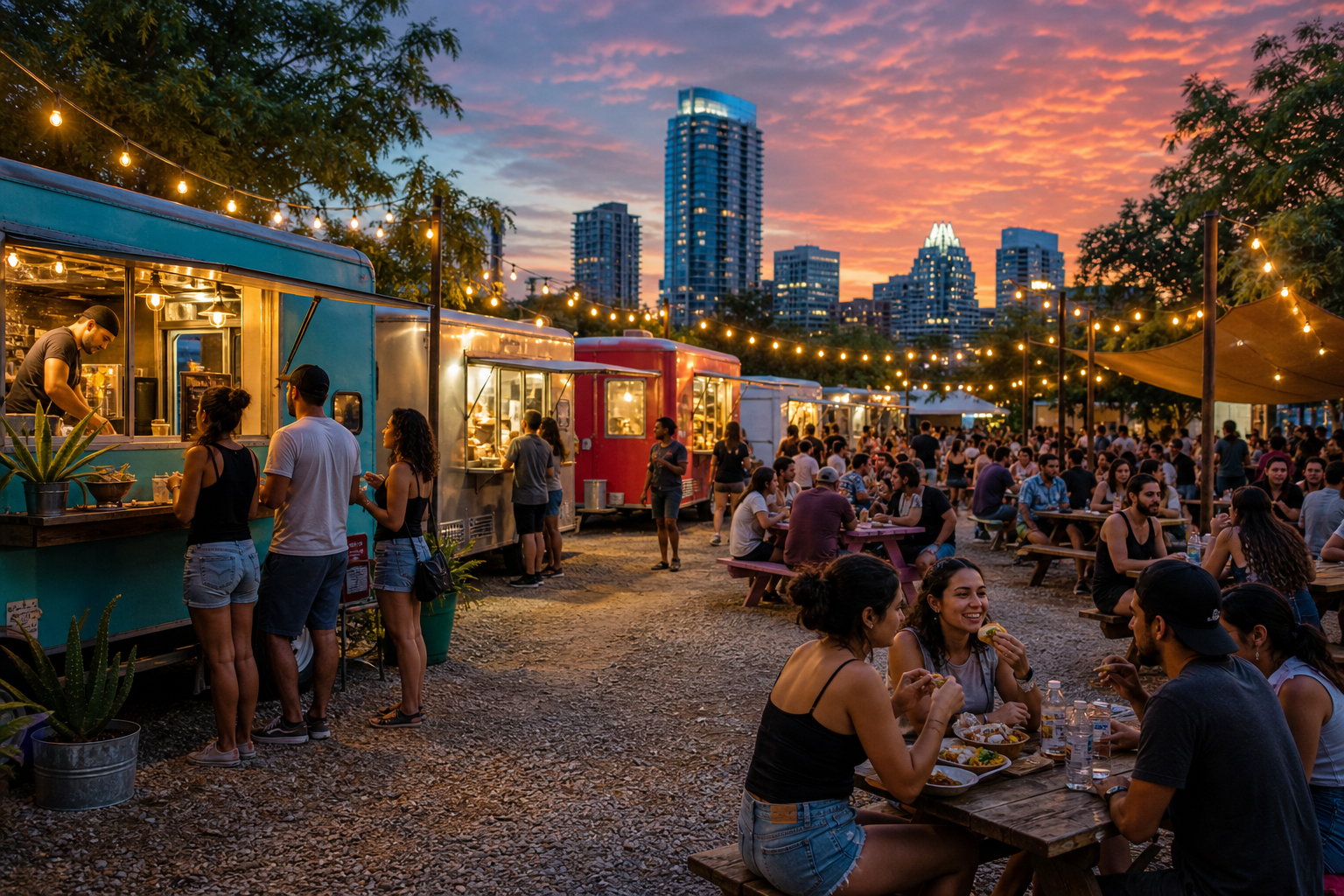
Austin's food truck culture dates to at least the 1990s and has never been a trend waiting to fade. Trucks cluster in gravel lots, brewery parking strips, and along South First and East Cesar Chavez, forming semi-permanent parks where a dozen cuisines share the same address. Some of Austin's most respected cooking comes from trailers, including barbecue trucks that sell out by early afternoon and close when the meat is gone rather than at a set hour. Trucks are busiest Thursday through Sunday. On payment: while cards and phone payment are now common at many trucks, individual cash-only trucks still exist, so carrying some cash remains a practical habit. Do not assume a card will work everywhere.
Vietnamese and Asian dining reflects real community roots
Austin's Vietnamese restaurant scene is not a recent trend. Vietnamese Americans were the largest Asian American population in Austin from the 1980s through the 2000s, and the community's estimated population today is around 20,000. Austin's Chinatown, centered at N. Lamar and W. Braker Lane, anchors a cluster of Asian-owned businesses and restaurants. The depth of Vietnamese, Chinese, and Thai options in Austin reflects decades of community presence, not a dining boom. Locals who know the city's Asian dining scene tend to head north of the river, away from the tourist corridors, where the restaurants are more neighborhood-facing and the menus less adapted for visitors.
Practical realities that shape how locals choose
Several habits separate locals from visitors when it comes to eating in Austin. Many popular spots do not take reservations, which means waits can stretch long on weekends, and locals tend to go early or late rather than at peak hours. The city's restaurant landscape shifts quickly as it grows, so a list from even two years ago may point to a closed kitchen or a changed concept. Neighborhood-level knowledge ages better than any ranked list. Locals also lean on food trucks for weekday lunches and neighborhood taquerias for late nights, rather than treating downtown as the default. The same logic applies in other fast-moving food cities, as the downtown Orlando restaurant guide illustrates.
How to find the right spot in Austin
- 1
Pick a neighborhood before a restaurant
Start with where you are or where you want to be. East Austin suits people who want a lively, creative atmosphere with a mix of cuisines. South Congress and South Lamar offer a more relaxed, walkable stretch. Rainey Street works for late-night eating. The neighborhood sets the tone more reliably than any individual listing.
- 2
Decide between sit-down and food truck
Food trucks in Austin are not a fallback option. Some of the city's most respected cooking happens out of trailers, particularly for barbecue and tacos. If you are going to a truck, go earlier than you think you need to. Barbecue trucks in particular sell out, often before a posted closing time, and do not reopen once the meat is gone.
- 3
Check the reservation situation before you go
Many of Austin's most popular spots do not take reservations, or take only a portion of their tables as walk-ins. Arriving at off-peak times, such as before 6:30 p.m. on weeknights, reduces waits significantly. For spots that do take reservations, booking a few days out is standard for weekends. Assuming you can walk in on a Saturday night at 7 p.m. will cost you time.
- 4
Carry cash even if you prefer cards
Cards and phone payment are now accepted at most Austin food trucks, but individual cash-only trucks still operate throughout the city. Having cash on hand prevents an awkward situation at a truck park where not every vendor takes the same payment. A small amount covers most scenarios.
- 5
Use neighborhood knowledge over ranked lists
Austin's dining scene changes fast. Restaurants close, concepts pivot, and new openings shift which blocks are worth visiting. A neighborhood-level understanding of the city, knowing that East 6th is innovative and dense, that South First has strong food truck clusters, that North Loop is quieter and local-facing, ages better than any single top-ten list. Local guides like this one, or the Sioux Falls restaurant guide for another city's approach, show how neighborhood framing keeps recommendations relevant longer.
Benefits
Neighborhood framing over ranked lists
Understanding Austin by neighborhood gives you a mental map that stays useful as the city changes, unlike a single ranked list that can be outdated within months.
Food trucks as a genuine dining option
Austin's truck culture is decades old and produces some of the city's most respected cooking. Treating trucks as infrastructure rather than novelty opens up a large part of the city's food scene.
Vietnamese and Asian dining with real community depth
Austin's Vietnamese restaurant scene reflects a community established since the 1980s, giving the city's Asian dining options a depth and authenticity that goes well beyond trend-driven openings.
Practical habits that reduce friction
Knowing when to arrive, whether to carry cash, and which neighborhoods suit which moods removes the guesswork that turns a good meal into a frustrating evening.
Situations where this guide makes a real difference
A visitor who wants beyond the tourist trail
A traveler who has already done the famous barbecue pilgrimage wants to eat the way residents do for the rest of their trip. Knowing to head to East Cesar Chavez for tacos, to a South First truck park for lunch, and to a North Loop neighborhood spot for dinner gives the trip a different texture entirely. The distinction between tourist corridors and local-facing streets is the most useful piece of knowledge a visitor can have.
A new Austin resident mapping the food landscape
Someone relocating to Austin often arrives with a mental map built from national media coverage, which skews heavily toward a handful of famous names. Understanding that Vietnamese dining is rooted in a decades-old community in North Austin, that food trucks are a legitimate daily dining option, and that each neighborhood has its own personality helps a new resident build a real sense of the city's food culture faster than working through a generic top-ten list.
A group planning a late-night meal after a show
Live music and late nights are inseparable in Austin. After a show on Red River or at a venue near East 6th, the question of where to eat past 10 p.m. is a real one. Rainey Street and parts of East Austin have late-night options, but knowing which spots stay open and which wind down early saves the group from wandering. Pairing a music night with a pre-planned late-night spot is how locals handle it. For finding the show first, a guide like live music in Milwaukee tonight shows how local event guides and dining guides work together.
A local looking to explore outside their usual neighborhood
Even long-time Austin residents often default to a handful of familiar spots near home. The city's size and the speed at which new restaurants open means there are almost always worthwhile places in neighborhoods they have not explored recently. East Austin in particular has changed significantly over the past several years, and a resident whose mental map is a few years old may be surprised by what has opened along East 6th and the surrounding blocks.
Austin restaurant guide: questions locals actually ask
Find your next Austin meal through local knowledge
Austin's food scene rewards people who know where to look, and Local Eyes is built to help you look in the right places. Browse restaurant listings by neighborhood, read what locals are saying, and find the spots that fit your night, whether that is a truck park on South First or a sit-down dinner on East 6th.